Oops! Something went wrong while submitting the form.
Start the conversation
Tell us briefly about your organisation and what you're trying to understand. We'll come back to you within one business day.
Thank you! Your submission has been received!
Oops! Something went wrong while submitting the form.
No obligation. No sales pitch on the first call. The conversation starts where your questions are.
Xempla Product Digest | August & September 2026
Published on :
October 1, 2026
Views...
This digest covers the releases Xempla shipped across August and September 2026. The theme running through them is closure: making sure every finding, whether it comes from a verification report, an AI inspection or a fault, reaches an owner, an action and a verified outcome.
June and July connected the steps of the work. August and September were about making sure those connected steps actually finish.
What we said was coming, and what happened
The last digest set out four commitments for August. Here is where each one landed.
Document workflow automation, extended. Delivered. HTM 03-01 verification in UK Health & Care now runs end to end, from report to action (details below).
Ticketing for Soft FM. Delivered. Inspection findings now become tickets automatically, live across 5 facilities in India.
Soft FM quality assessments into the governance layer. Delivered in September, a month later than planned.
Multi-pipeline reasoning for Omi. Moved to January. The single agentic triage pipeline is holding up well on the fault volumes we see today, so we put August and September into the Soft FM and HTM work that customers needed sooner.
Executive Summary
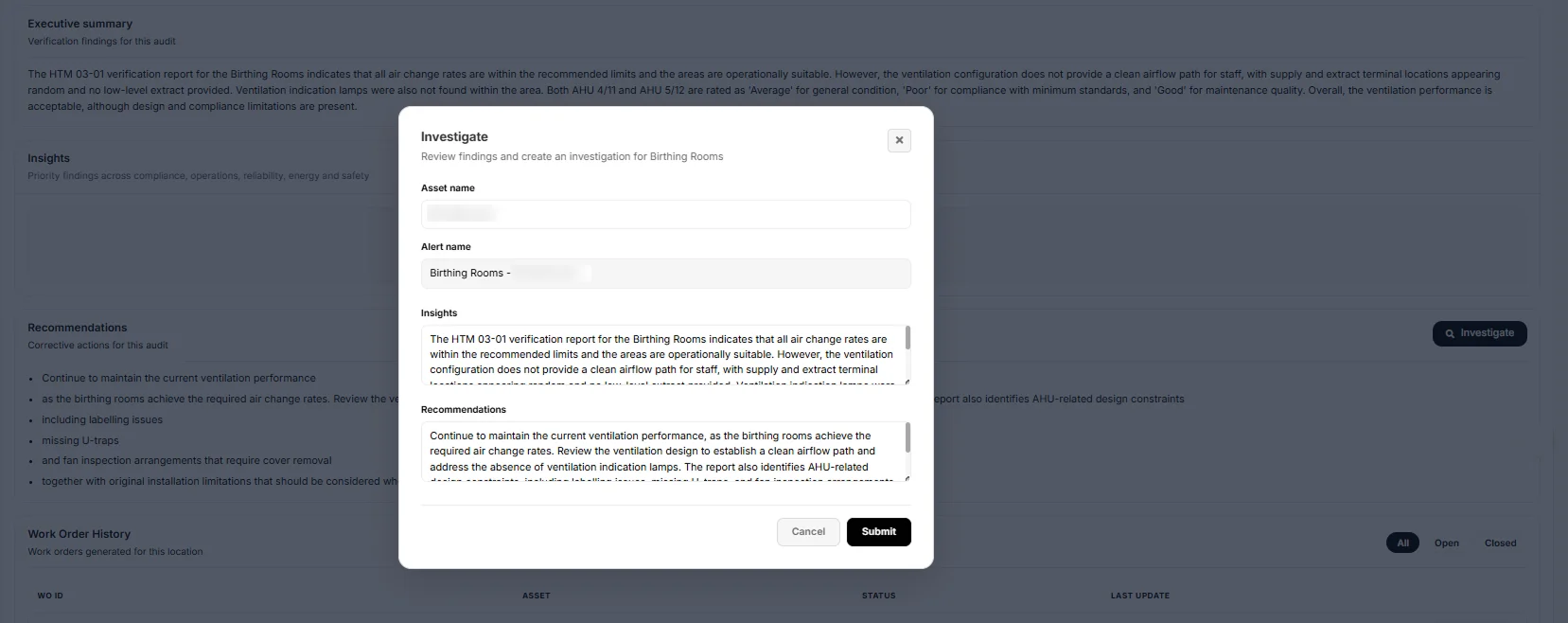
HTM 03-01 verification, automated: Verification reports are read, analysed and routed into the DIIV cycle, so critical findings reach the people who need to act on them. This now covers 150 locations, with around 70 reports automated so far.
Soft FM, from inspection to outcome: AI inspection findings become tickets, quality checks roll up from location to facility, and a two-page business review is generated automatically.
Engineering governance on mobile and web: Engineering managers see where risk and opportunity sit across five domains, with human supervisory notes where the stakes are highest.
Conversational interface on mobile: Technicians can ask about the history and configuration of any asset.
Xempla for individual engineers: Engineers can run asset inspections from a personal account.
RELEASED: HTM 03-01 VERIFICATION, END TO END
From verification report to verified action
In UK healthcare, HTM 03-01 governs specialised ventilation. Systems serving critical areas such as operating suites are inspected quarterly and have their performance verified every year. Those verification reports contain findings that matter well beyond the plant room. In a clinical setting, ventilation is part of infection control.
The workflow now covers the whole journey. A verification report arrives and is read and analysed automatically. Any issues are surfaced in the governance layer and linked to a workflow in the DIIV cycle (Discover, Investigate, Implement, Verify), so every finding has an owner and a route to closure.
Findings from verification reports under HTM 03-01 can be converted into structured investigations, connecting identified issues to a workflow for resolution.
Why this matters: Verification has been failing in two different ways. The first is time. Engineers either didn't have time to review the reports, or reviewed them but couldn't act before the moment had passed. The second is visibility. Some findings are critical to compliance and commercial teams, yet those teams either had no access to them or lost them somewhere in the handoffs. Automating how reports are read addresses the first problem. Linking findings to the workflow they should trigger addresses the second.
What's changed so far: The workflow covers 150 locations in UK Health & Care, and around 70 verification reports have been processed automatically to date. For a service provider running it end to end, the result is higher engineering productivity, tighter governance and control, and better service delivery for the client.
RELEASED: SOFT FM, FROM INSPECTION TO OUTCOME
Inspections that change what happens next
Supervisors run quality checks and inspections every day. The long-standing problem has been what happens afterwards. An inspection records a problem, but nobody can be sure the record ever leads to anything in operations. Across August and September, we connected the full chain.
1. Inspection findings become tickets (August). When an AI inspection finds an issue at a location, the facility's own governance configuration decides whether the finding's priority justifies a ticket. If it does, the ticket is raised automatically and assigned to the supervisor and on-site team for corrective action. This is live across 5 facilities in India.
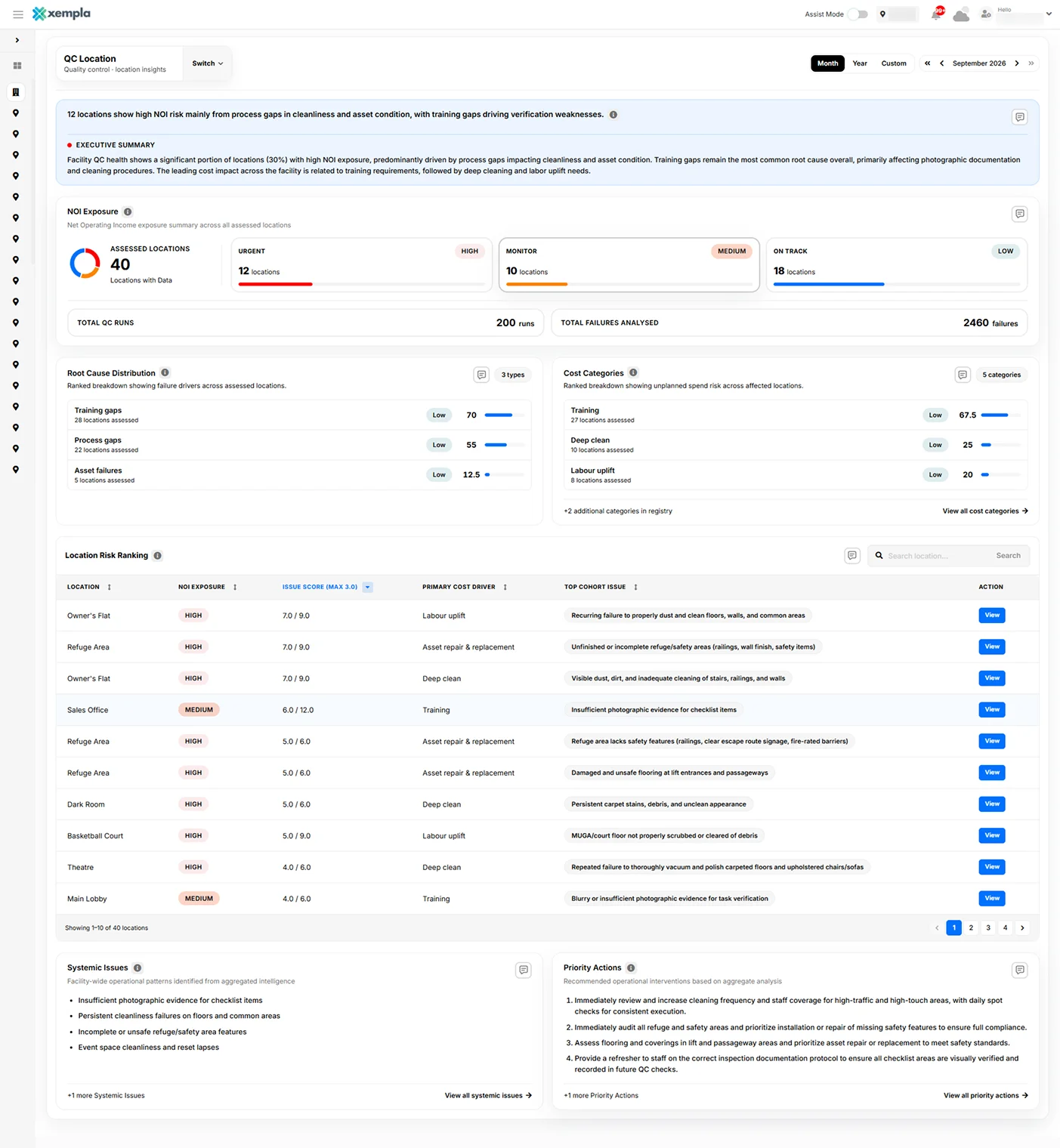
2. Quality governance from location to facility (September). Quality checks on each checklist now roll up to the location and then to the whole facility. This gives the service provider one view of whether the soft services regime is working and where the gaps are. It also surfaces the early signs of cost overrun, such as training gaps, upskilling needs and more deep cleaning than planned, so teams can act on them before they show up in the budget.
Quality governance rolls checklist results up across locations, making performance gaps and emerging cost risks easier to see and act on.
3. The automated business review. Most monthly business reviews are long documents that very few people read. This one is a two-page note generated automatically from what is happening in Xempla: checklist completion rates, quality check coverage, tickets raised, and recurring issues grouped by location and category. It can be scheduled monthly or weekly by the service provider, the owner-occupier or the managing agent.
Why this matters: A soft services provider can now show that its inspections lead to better outcomes, not just a record of what was wrong. For the client, it is the difference between seeing a quality score and seeing quality actually improve.
RELEASED: ENGINEERING GOVERNANCE, ON MOBILE AND WEB
Where the risk and opportunity actually sit
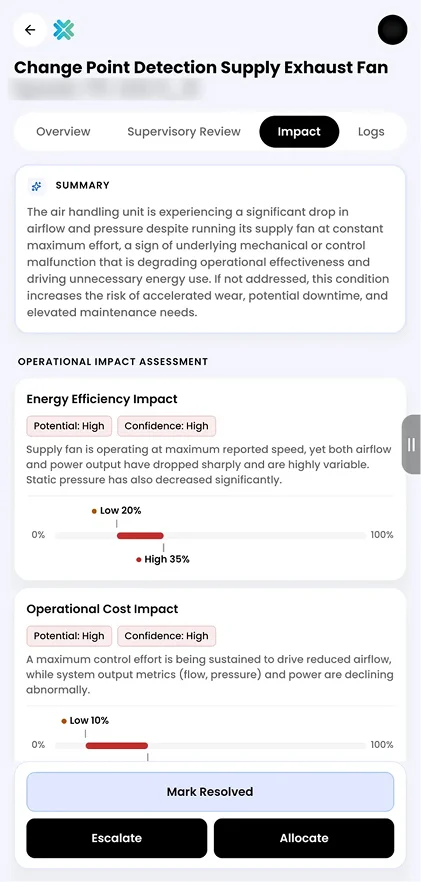
June and July brought the governance layer to executives. In August, we brought it to engineering managers, on both the mobile and web apps. The view covers six domains: lifecycle, reliability, maintenance, energy, operations and service delivery. . It shows which assets carry the most risk or the most opportunity to improve service delivery. It is live on every site where Xempla operates.
Impact assessments surface potential risk and opportunity alongside confidence levels, helping teams prioritise where action matters most.
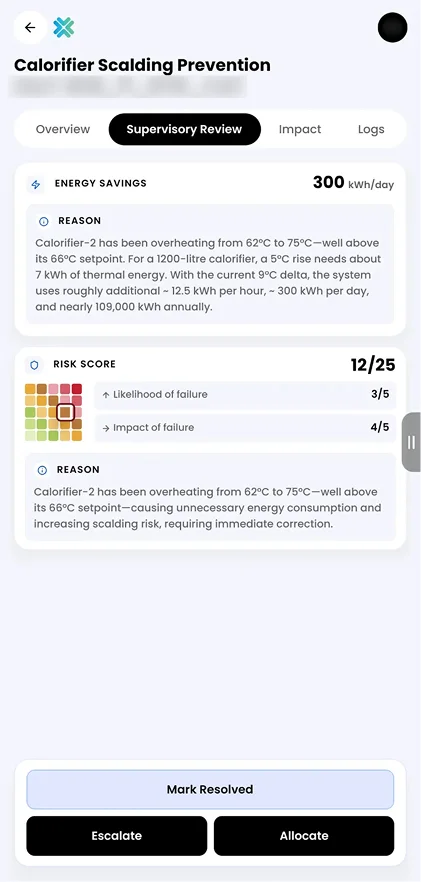
We also added human supervisory notes to risk and energy-saving assessments. The triage agent ranks every fault across several domains. Where the risk or opportunity is highest, a human reviewer adds a note. Planners can then see that a finding is both high-opportunity and human-reviewed, and prioritise it with confidence.
Risk and energy-saving assessments show potential failure impact and energy-saving opportunities, helping teams prioritise where attention matters most.
Why this matters: Agentic ranking works at a scale no team can match, and human judgment carries weight that no ranking can. Notes are added selectively, only where the stakes justify them, so when a note appears, planners know it deserves their attention.
RELEASED: CONVERSATIONAL INTERFACE ON MOBILE
Answers for the questions a work order doesn't cover
Our design principle hasn't changed. When a work order is generated, everything a technician needs to do the job should already be there, without them having to ask. But technicians still have their own questions. They may be new to a site, or want to understand how an asset was configured or what happened to it before.
The conversational interface, released in August, is for those questions. It draws on the context available in Xempla, making information easier to find and helping close the skills gap for engineers who haven't built up years of knowledge about a particular site.
RELEASED: XEMPLA FOR INDIVIDUAL ENGINEERS
Some tools should be accessible to everyone
Xempla is now available to individual engineers, not only to organisations. Engineers sign up with a personal email address and receive 25 credits a month. They start with a complete asset inspection workflow that handles audio, video and other input types. It is equally suited to small and medium businesses.
It is currently in invite-only beta available globally, with wider access to follow.
It is part of a belief we have held since the start of Forever Forward: some tools should be accessible to everyone. We'll see how it goes.
COMING: OCTOBER & NOVEMBER
We are continuing with the same thesis. The work under way includes:
Fault assistance for individual engineers: Help at the asset when something looks wrong, drawing on the context Xempla holds for that asset and on the triage knowledge built up over time.
Sequential work order routing: Complex faults often need several teams in order, for example controls first and then HVAC or mechanical. Routing will support that sequence.
Field services at greater scale: Tickets that become work orders, customer approval steps where needed, and support for service providers who run mobile engineering units rather than dedicated teams at each site.
Deferred maintenance planning: New skills to help planners and schedulers decide how and when activities should be planned.
We'll share what ships as it ships.
The Bigger Picture
June and July connected the steps. August and September made sure the connected steps finish. A verification finding now reaches the person who has to act on it. An inspection result becomes a ticket, the ticket leads to a fix, and the fix appears in a two-page review a client will actually read. A fault ranking arrives with a human note where it matters most.
None of this adds new places to look. It makes sure that what the system finds goes somewhere.
Our thesis:A governance layer is only as good as how few systems a decision-maker has to move through to reach a decision, and how reliably that decision reaches an outcome. That is the System of Decisions, built one seam at a time.