Oops! Something went wrong while submitting the form.
Start the conversation
Tell us briefly about your organisation and what you're trying to understand. We'll come back to you within one business day.
Thank you! Your submission has been received!
Oops! Something went wrong while submitting the form.
No obligation. No sales pitch on the first call. The conversation starts where your questions are.
Energy Optimisation in Facilities Management: The Role of Everyday Decisions
Published on :
July 15, 2026
by
Anisha Bhattacharjee
Views...
Deloitte's 2025 C-suite Sustainability Report surveyed more than 2,100 executives across 27 countries and found that sustainability remains a top three priorities on the corporate agenda, alongside technology adoption and AI. The finding wasn't specific to any one function, but for facilities management, a significant portion of many organisations' operational sustainability commitments is ultimately delivered through how their buildings perform.
Sustainability itself is a broad mandate. It touches supply chains, materials, water, waste, and reporting obligations across an entire enterprise. For facilities management, energy is one of the most important operational levers, because it drives a significant share of a building's operational emissions while remaining one of the few costs a team can actually influence day to day. JLL research shows electricity costs run between 4% and 26% of a building's rental value depending on the market. Unlike many sustainability initiatives, energy optimisation often delivers environmental and financial benefits simultaneously.
Budgets are tight, capital projects are scrutinised harder than ever, and buildings themselves are increasingly treated as business outcomes rather than background infrastructure. In that environment, energy is one of the few areas where operational teams can show real, near-term financial benefit without waiting on capex approval.
Energy Optimisation Doesn't Need Its Own Program
Energy performance often gets treated as something that needs its own initiative: a retrofit, a new monitoring platform, a separate energy team running alongside the rest of operations. In reality, most of the opportunity sits inside decisions FM teams are already making. A setpoint adjustment, a scheduling change, a delayed response to a drifting damper, a maintenance call that gets deprioritised. Almost every operational decision carries an energy consequence, whether or not anyone is tracking it as one. Energy optimisation isn't necessarily a separate category of work. It's often a property of well-run operations.
This isn't a marginal effect. Research from the U.S. Department of Energy's Pacific Northwest National Laboratory (PNNL) has found that as much as 30% of the energy consumed by commercial buildings is excess that comes from how the building is operated, not from equipment breaking down. Buildings don't waste energy because engineers make bad decisions. They waste energy because thousands of perfectly reasonable operational decisions get made without anyone seeing their energy consequence.
Why This Waste Is Hard to See
Some of this waste comes from outright faults: a stuck valve, a failed sensor, a damaged actuator, and those are relatively easy to catch once someone is looking. But some of it comes from something quieter: drift. A chiller sequencing slightly off its optimal schedule. A VAV box holding a setpoint that made sense a year ago but not today. Nothing had failed. The system simply wasn't performing as efficiently as it should have, day after day, with the impact only becoming visible later through higher energy use or an unexpected utility bill.
The tools that exist today can see pieces of this picture. BMS platforms, meters, CMMS records and monitoring dashboards each hold part of the story, but they largely sit apart from each other and apart from the operational workflow itself. A BMS trend might show the drift. A CMMS might show the last maintenance action. Neither is set up to connect the two and decide what the deviation actually means, or what it's costing in energy while it goes unaddressed.
Making Every Maintenance Decision Energy-Aware
The fix isn't asking engineers to manually connect trends, work orders, maintenance history and asset behaviour on top of everything else on their plate, especially when what's sitting inside that connection is often an energy cost no one has traced yet. It's giving them a workflow, built on an AI-native layer, that does that connecting for them, so drift gets flagged and investigated while it's still small, before it turns into a utility bill nobody can explain. The engineer still makes the decision, unless configured otherwise. What's different is that the groundwork is already done, so tracing what a drift is costing takes minutes, not a manual pull across three systems.
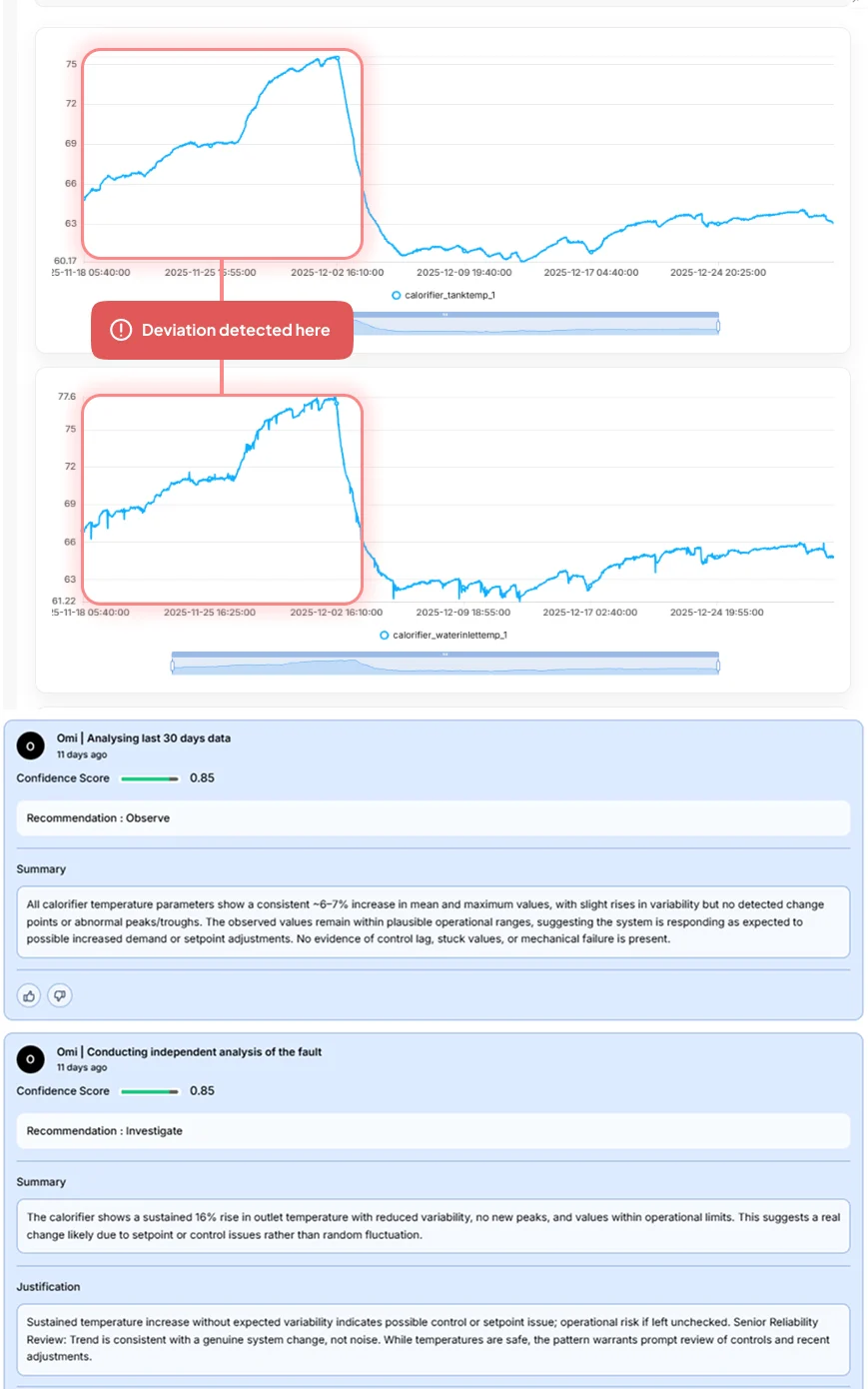
One example of this in practice comes from a hot water calorifier at one of Xempla's client sites. The 1200-litre unit had run stably for months, holding its outlet temperature around 65°C with the kind of modulation pattern that Omi had already learned to recognise as normal. In mid-November, that pattern started to shift and temperature began climbing toward 75°C. Omi flagged it as a real operational change, not noise.
The investigation pointed to the steam regulating valve. On-site inspection confirmed it: the valve was being commanded closed at 65°C, but the actuator wasn't responding, and steam was leaking into the tank continuously. Nothing had failed catastrophically. The valve simply wasn't closing when it was told to, and the tank kept absorbing heat it didn't need.
The fix, once identified, was straightforward: repair the actuator and restore normal valve modulation. What made the case worth flagging wasn't the repair itself but what the drift was quietly costing before anyone looked. At a sustained 9°C rise, the tank was consuming roughly 12.5 kWh more per hour than it needed to, which works out to close to 300 kWh a day, and left unaddressed, over 100,000 kWh a year. There was also a second dimension to it: a calorifier running that far above its design range isn't just wasteful, it's a scalding risk. Omi's flag caught both consequences of the same drift at once.
Outlet temperature rising past its normal range, the drift Omi flagged as a real operational change, not noise.
This isn’t an isolated incident. Across larger portfolios, the same operational pattern appears repeatedly. A UK health and care FM provider has recovered more than 3 million kWh to date by running this approach across its portfolio, and a large APAC healthcare estate saw an early operational assessment surface 25% to 40% of energy optimisation potential simply by comparing what the systems assumed was happening against what was actually happening on site.
Why This Works Where a Dashboard Alone Doesn't
Traditional monitoring tools are good at surfacing anomalies. Where they tend to fall short is what happens next: whether a deviation is worth investigating, why it's happening, and what it's likely costing while it goes unaddressed. Without that step, alerts pile up in a queue and every one of them looks equally urgent, or equally ignorable, with no way to tell which ones are quietly burning energy. The calorifier case above is a good illustration. A standard setup would have seen the temperature climb, maybe logged it, and moved on once nothing failed outright. What made the difference here was flagging the drift as a real change worth looking into, rather than noise, which is what led to the investigation that found the leaking valve and the energy cost behind it.
This is what Xempla's System of Decisions is built to do. The BMS, CMMS and monitoring tools an FM team already uses don't get replaced, they keep doing exactly what they do. Xempla sits above them, pulling in what they're already seeing and connecting it to work orders, asset history and past decisions to figure out whether a deviation matters and why. In practice, every deviation moves through the same cycle: Discover what's changed, Investigate why, Implement the right response, and Verify the outcome. Xempla calls this the DIIV Cycle. Where the pattern is well understood, it returns a clear recommendation, whether that's an action worth taking or something safe to leave alone. Where the situation falls outside its confidence, it hands the case to an engineer with the full picture already assembled, what's changed, what's related, what's happened before, so the decision still gets made by a person, without having to piece that together first. It's that context, not a raw alert, that turns a drifting temperature or a fraction-off schedule into a number worth acting on, the same way it did with the calorifier.
A fuse quietly failing, a pressure trip that recovers on its own, a chiller a fraction off its optimal schedule: none of them look urgent in isolation, and that's exactly why they usually go unaddressed. Every maintenance decision is also an energy decision, whether or not it's treated like one. Which means energy optimisation isn't another programme to run alongside facilities management. It's what happens when those everyday decisions are continuously informed, prioritised and verified. The biggest energy savings don't begin with new programs. They begin with better decisions.
FAQs
What is energy optimisation in facilities management?
Energy optimisation in facilities management is the practice of reducing a building's energy consumption through better day-to-day operational decisions. Most of the opportunity comes from catching inefficiencies like sensor drift, delayed maintenance responses, and suboptimal setpoints before they add up into higher energy use.
How much energy do commercial buildings waste due to poor operations?
Research from the U.S. Department of Energy's Pacific Northwest National Laboratory (PNNL) has found that as much as 30% of the energy consumed by commercial buildings is excess that comes from how the building is operated, not from equipment failure.
Does energy optimisation require a separate program from regular maintenance?
No. Many energy savings come from decisions FM teams are already making, such as setpoint adjustments, maintenance scheduling, and response times to equipment alerts. Embedding energy awareness into existing operational workflows is typically more effective than running energy management as a standalone initiative.
What percentage of a building's operating costs come from energy?
According to JLL research, electricity costs run between 4% and 26% of a building's rental value depending on the market, making energy one of the largest controllable operating expenses for facility owners and operators.
How does AI help with energy optimisation in buildings?
AI-native platforms can continuously monitor building systems, connect signals across BMS, CMMS, and maintenance history, and flag deviations before they escalate into equipment failures or unnecessary energy waste. This reduces the manual effort required to catch drift and inefficiencies that traditional monitoring tools often miss.